After a one-hour car journey, two hours on a plane, a two-hour layover, a further three-hour flight and four hours in the car on arrival - 2,450 km later and nearly giving in to the kind of delirium that comes from endless waiting - we arrived in Shanxi province. From the very first moment it was clear that this place was different. Driving through cliffs covered in lush greenery, I could finally recognise the China I had seen in films.
The Hemp Story: Part 2
Our Sustainability Manager’s recent journey to China uncovered the
story of one of nature’s most remarkable fibres - hemp. From the fields
where it grows to the factory where fibres become fabric,
every step revealed an extraordinary blend of heritage, innovation, and human
touch. Read on for Liene’s story of how people, skill,
and passion come together to create one of POETRY's favourite
fabrics.
YARNS IN THE MOUNTAINS
After a one-hour car journey, two hours on a plane, a two-hour layover, a further three-hour flight and four hours in the car on arrival - 2,450 km later and nearly giving in to the kind of delirium that comes from endless waiting - we arrived in Shanxi province. From the very first moment it was clear that this place was different. Driving through cliffs covered in lush greenery, I could finally recognise the China I had seen in films.
The next morning, we set out to explore hemp fibre processing and spinning. Winding through the mountain roads, our driver explained that the factory has been operating since 1969 and now has two sites. The first, the oldest, still runs with its original machinery and processes fibres to cloth as it has for decades. The second is a newly built, state-of-the-art facility, designed for efficient, large-scale yarn spinning and fabric weaving.
The next morning, we set out to explore hemp fibre processing and spinning. Winding through the mountain roads, our driver explained that the factory has been operating since 1969 and now has two sites. The first, the oldest, still runs with its original machinery and processes fibres to cloth as it has for decades. The second is a newly built, state-of-the-art facility, designed for efficient, large-scale yarn spinning and fabric weaving.
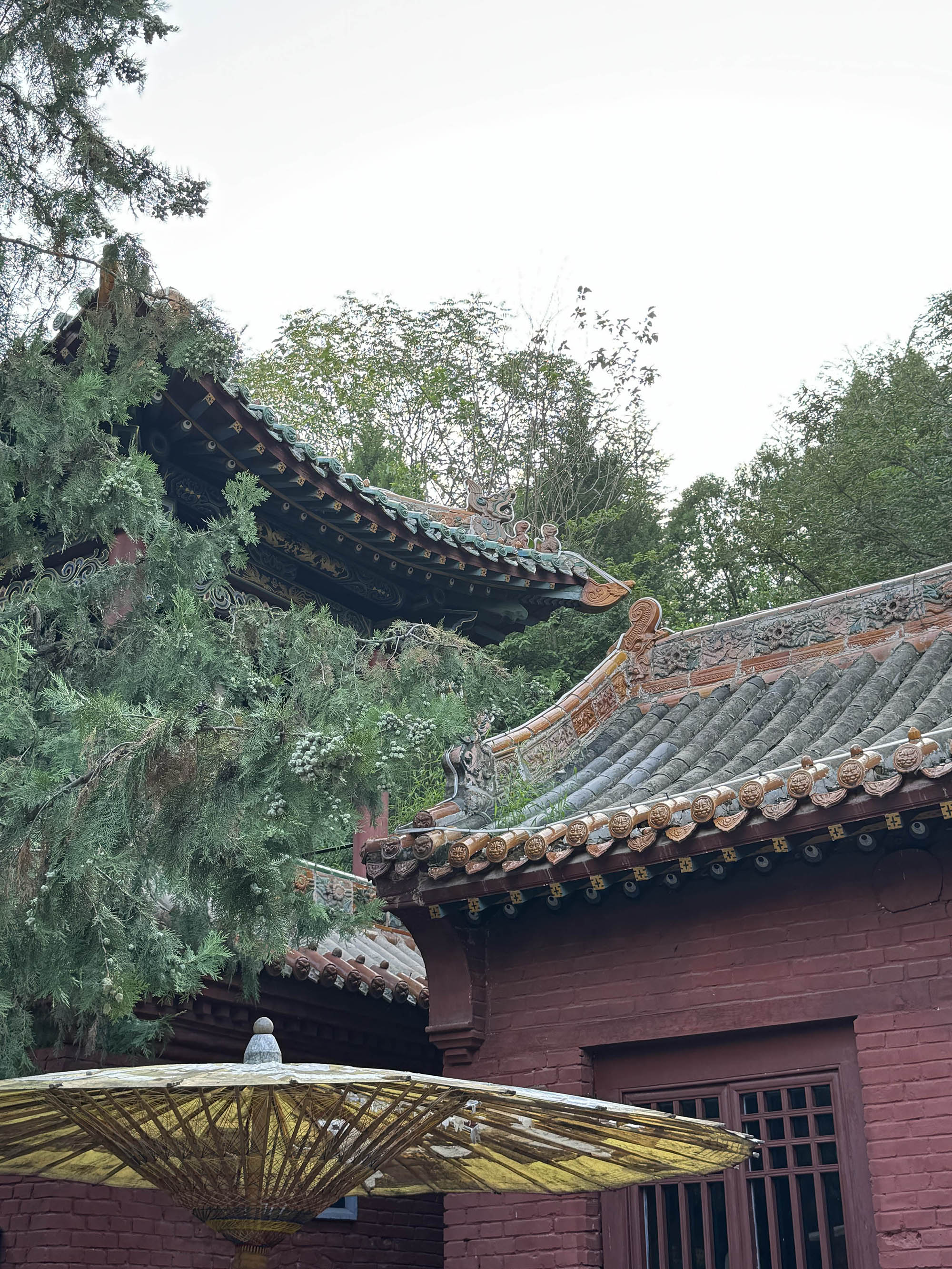
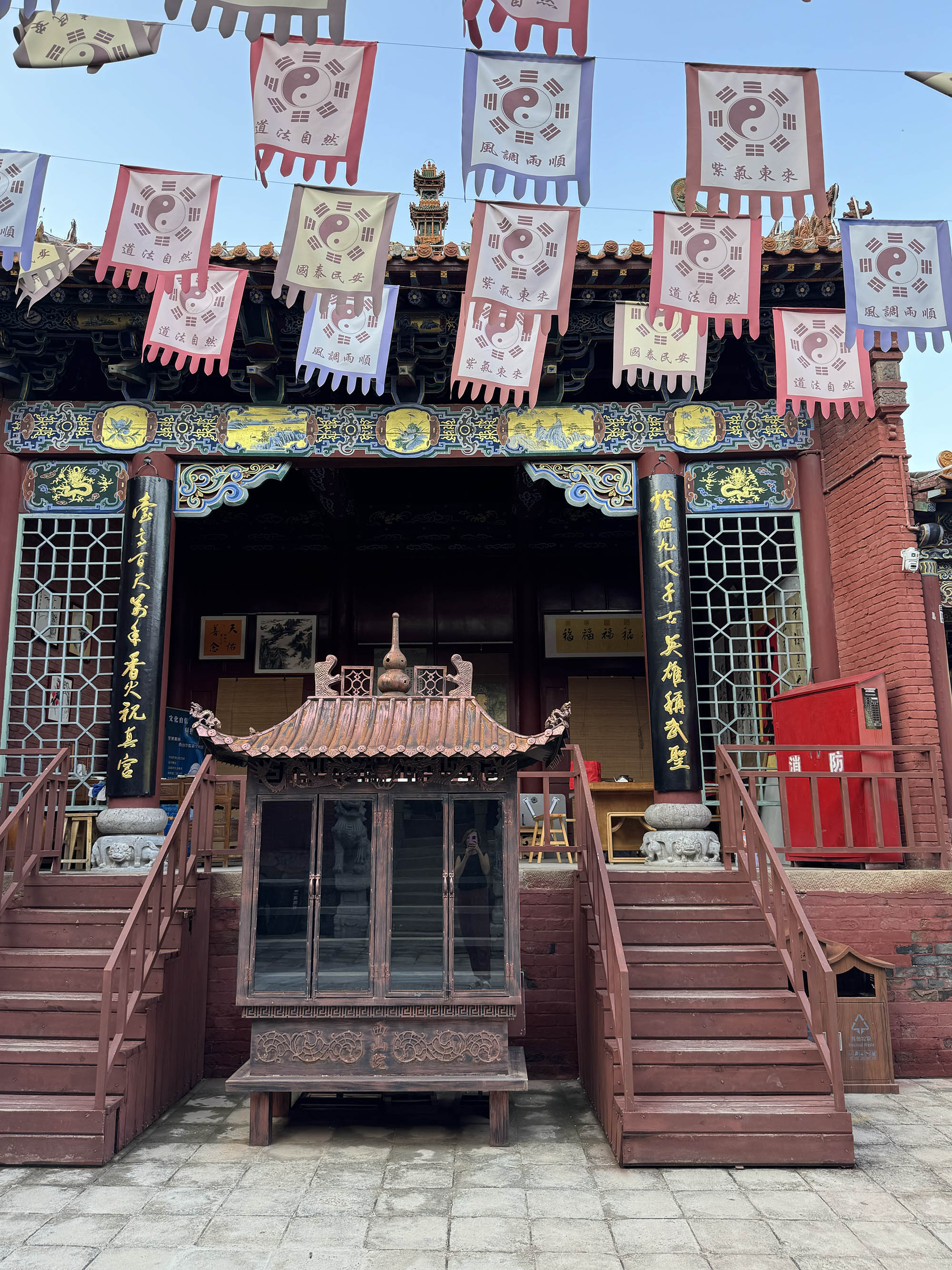
As I learned later, the factory predates even that official founding date. Originally, it produced cotton fabrics for the Chinese military and its picturesque location among cliffs was no accident. It was meant to be hidden and protected from enemy military attacks. Shanxi is one of the few regions in China that, despite the country's rapid development, has preserved much of its traditional heritage. The temples still welcome businessmen who have been coming here to pray for prosperity for centuries. Among other things, this province is famous for its two-hour lunch breaks, bowls of noodles, and the sacred midday nap. Somehow, the combination of these three felt like more than mere coincidence.
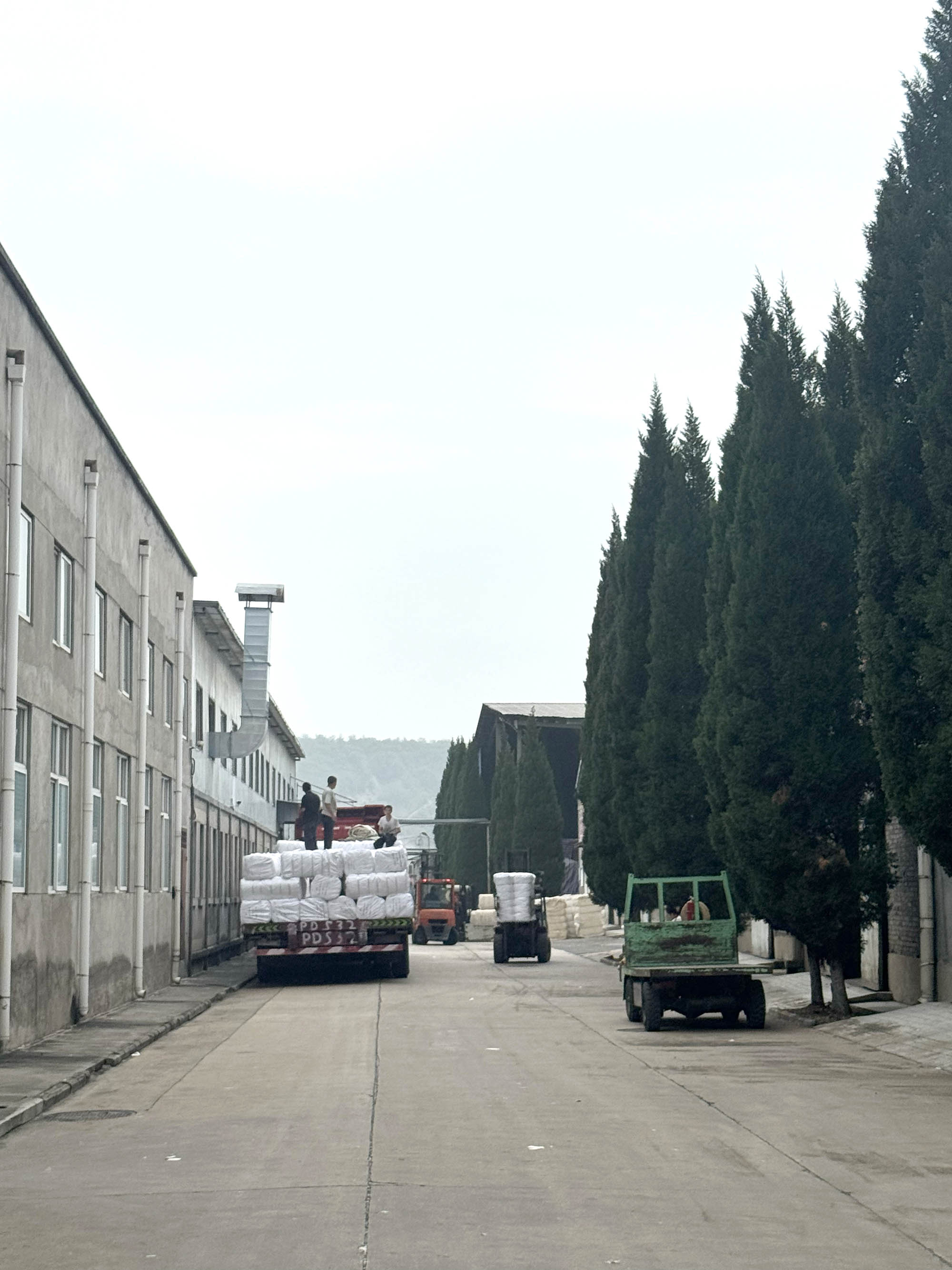
We began our tour in a vast warehouse stacked with bales that, at first glance, resembled hay, but looking more closely had the distinctive silvery sheen that sets hemp fibres apart. In different corners were piles of long fibres- before further processing reaching 80 cm in length, and shorter fibres- of around 20 cm. Anything under 5 cm is known as hemp fleece, which is unsuitable for yarn production. Alongside hemp were other materials such as linen, cotton and man-made cellulosics that are usually blended and spun together with the shorter hemp fibres.
FROM FIBRE TO YARN
The first stage of processing took us into a room lined with large barrel-shaped containers. Workers were stacking raw fibre onto large metal frames with hooks, which were then immersed in the vats filled with solutions (and bleach if necessary) for seven to eight hours in a process called degumming. Hemp fibres are naturally bound together by a sugary gum. This gum is first broken down by sugar-loving microorganisms during the retting process in the field and then fully removed in degumming, allowing the fibres to separate.
Once dried, the fibres pass through a light application of oil and are left for a week to absorb it. From here, the processing diverges. Long fibres can be spun into pure hemp yarn, while shorter ones are typically blended with fibres such as organic cotton.
Because hemp, like linen, lacks elasticity, it is always handled in high humidity. Every ceiling is fitted with a sprinkler-like system that keeps the air moist, creating an almost tropical climate. Pure hemp yarn is also spun in these conditions using specialised machinery in a process known as wet spinning.
I am always struck by how textile production happens almost between two worlds: using techniques, like sewing, that have remained virtually unchanged for thousands of years, and others that are now unrecognisable from their traditional form with hardly any human involvement. Yarn spinning belongs firmly to the latter.
Yarn spinning takes place on machines that stretch the entire length of a warehouse and is increasingly in speed with each processing stages. Before fibres are spun, they are blown, mixed, combed and drawn into long, rope-like locks about the thickness of a thumb called slivers. To ensure consistency, slivers from different batches are combined, then repeatedly combed and drawn depending on the thickness of the intended yarn. The finer the yarn, the more crucial it is for the fibres to be perfectly aligned, and the more refining is required.
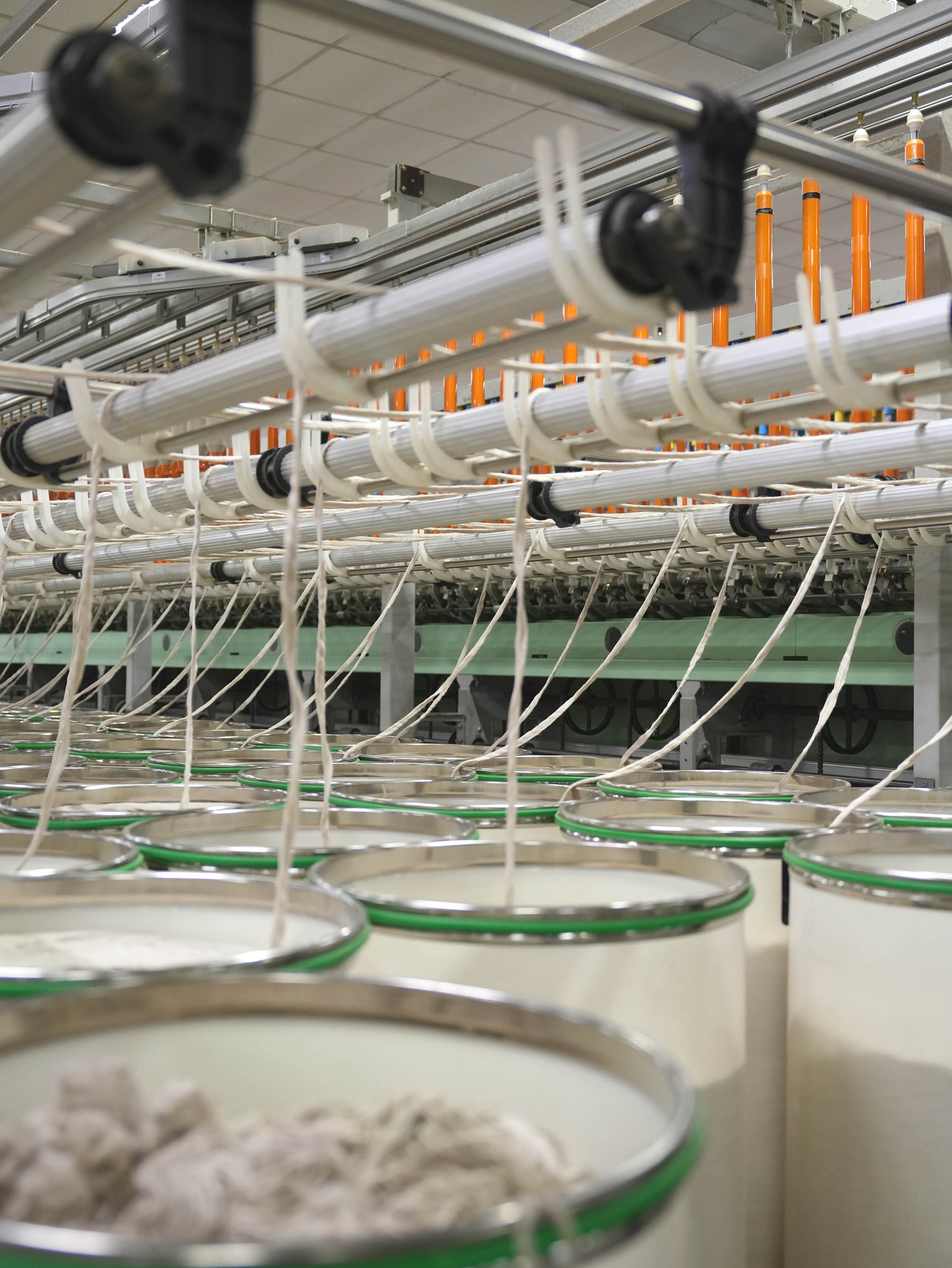
There is something delicate about the first stages of yarn making, much of which takes place unseen in pipes running along the ceilings or within large, concealed grey machines. What can be observed are the smooth slivers of fibre slowly coming out of machines, repeatedly lifted and neatly laid down into buckets. There is a quiet beauty in these soft strands, gently arranged into patterns, then slowly gathered up again for further refinement, only to be gently laid back once more.
FROM FIBRE TO YARN
The first stage of processing took us into a room lined with large barrel-shaped containers. Workers were stacking raw fibre onto large metal frames with hooks, which were then immersed in the vats filled with solutions (and bleach if necessary) for seven to eight hours in a process called degumming. Hemp fibres are naturally bound together by a sugary gum. This gum is first broken down by sugar-loving microorganisms during the retting process in the field and then fully removed in degumming, allowing the fibres to separate.
Once dried, the fibres pass through a light application of oil and are left for a week to absorb it. From here, the processing diverges. Long fibres can be spun into pure hemp yarn, while shorter ones are typically blended with fibres such as organic cotton.
Because hemp, like linen, lacks elasticity, it is always handled in high humidity. Every ceiling is fitted with a sprinkler-like system that keeps the air moist, creating an almost tropical climate. Pure hemp yarn is also spun in these conditions using specialised machinery in a process known as wet spinning.
I am always struck by how textile production happens almost between two worlds: using techniques, like sewing, that have remained virtually unchanged for thousands of years, and others that are now unrecognisable from their traditional form with hardly any human involvement. Yarn spinning belongs firmly to the latter.
Yarn spinning takes place on machines that stretch the entire length of a warehouse and is increasingly in speed with each processing stages. Before fibres are spun, they are blown, mixed, combed and drawn into long, rope-like locks about the thickness of a thumb called slivers. To ensure consistency, slivers from different batches are combined, then repeatedly combed and drawn depending on the thickness of the intended yarn. The finer the yarn, the more crucial it is for the fibres to be perfectly aligned, and the more refining is required.
There is something delicate about the first stages of yarn making, much of which takes place unseen in pipes running along the ceilings or within large, concealed grey machines. What can be observed are the smooth slivers of fibre slowly coming out of machines, repeatedly lifted and neatly laid down into buckets. There is a quiet beauty in these soft strands, gently arranged into patterns, then slowly gathered up again for further refinement, only to be gently laid back once more.
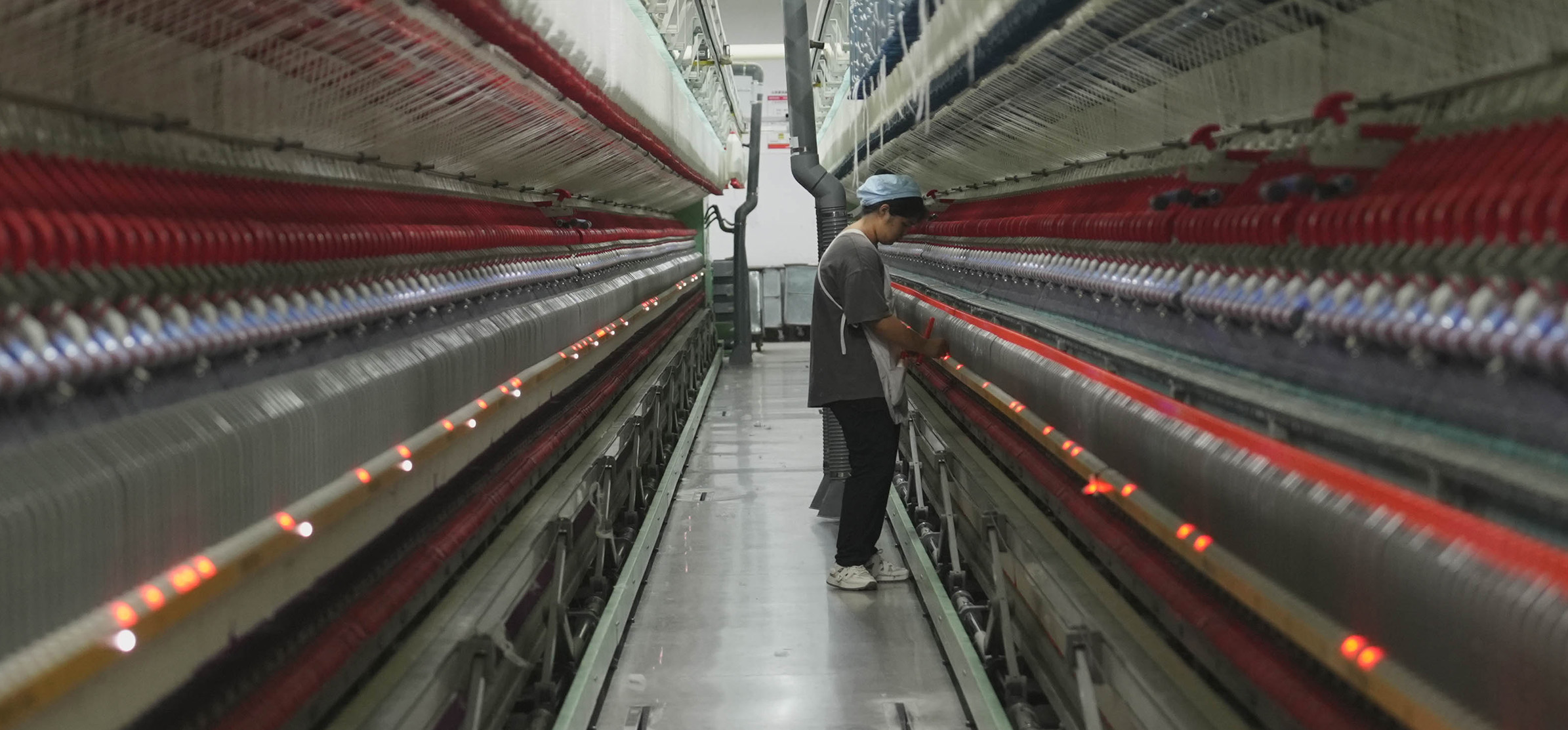
The spinning stage, by contrast, is far less graceful. It resembles a vast, perfectly organised wasp’s nest: endless rows of machinery, hundreds of parts, each vibrating at an almost alarming speed. Yarn is spun so quickly that, although the process unfolds right before your eyes, it remains almost invisible. At the top of each row, hundreds of cones unravel with astonishing speed, while below, hundreds more fill just as fast.
A handful of workers were moving steadily between the endless rows of machinery, ensuring everything kept running. They walked through the buzzing aisles of spinning cones, checking for errors. Each cone had a light on top that flashed if something went wrong. If a thread had snapped or a fault occurred, the machine would stop instantly and a worker would step in to resolve the issue so the hum of production could continue.
WEAVING LOOMS
Similarly in the weaving hall, hundreds of high-speed automatic looms stood side by side, each producing what seemed to be five to ten centimetres of fabric every minute. At their sides, cones of thread steadily diminished as the rolls of cloth grew ever larger. The fabric on the looms shivered under the force of the process, while the threads themselves were almost impossible to see, disappearing into the blur of rapid movement.
A handful of workers were moving steadily between the endless rows of machinery, ensuring everything kept running. They walked through the buzzing aisles of spinning cones, checking for errors. Each cone had a light on top that flashed if something went wrong. If a thread had snapped or a fault occurred, the machine would stop instantly and a worker would step in to resolve the issue so the hum of production could continue.
WEAVING LOOMS
Similarly in the weaving hall, hundreds of high-speed automatic looms stood side by side, each producing what seemed to be five to ten centimetres of fabric every minute. At their sides, cones of thread steadily diminished as the rolls of cloth grew ever larger. The fabric on the looms shivered under the force of the process, while the threads themselves were almost impossible to see, disappearing into the blur of rapid movement.
It was not only the scale but also the sound that was overwhelming. The relentless clatter of threads and metal moving at such speed left no space for conversation. Each fabric contained thousands of warp threads, the vertical threads on the loom, each with a tiny metal piece hooked onto it. As weaving took place, these metal pieces vibrated and knocked against one another. If one fell, it meant the warp thread it was attached to had snapped, instantly stopping the loom and signalling a worker for assistance.
Once again, workers moved calmly through this maze of pounding machinery, pausing occasionally to tend to the looms that had fallen silent. Watching them, it struck me that they seemed more like assistants to the machines than the other way round, a reminder of just how far we have come technologically since the days of the spinning wheel and weaving frame. It also made me wonder at the sheer scale of automation: if I could witness hundreds of cones of yarn being spun within minutes here, tens of meters per hour, how much material must be produced across the world every single day. A thought at once astonishing and somewhat intimidating.
Once again, workers moved calmly through this maze of pounding machinery, pausing occasionally to tend to the looms that had fallen silent. Watching them, it struck me that they seemed more like assistants to the machines than the other way round, a reminder of just how far we have come technologically since the days of the spinning wheel and weaving frame. It also made me wonder at the sheer scale of automation: if I could witness hundreds of cones of yarn being spun within minutes here, tens of meters per hour, how much material must be produced across the world every single day. A thought at once astonishing and somewhat intimidating.
Part 3: The hands who make our clothes